6/10/2010

Ohara is Fresh green leaves

Ohara is a rural town nestled in the muntains of northern Kyoto about an hour from Kyoto Station. It looked like a short trip even I live in Kyoto because of taking time to getting on a train.
Ohara is best known for Sanzenin Temple.


It is a large temple with a variety of buildings and gardens.


The fresh green moss extend as far as the garden and Japanese cedars were growing up as if they tried to reach to the sky.


Please look at the foot of the tree, you can see a small cute stone statue of Jizo. When I saw him I smiled in spite of myself.


Ohara is surrounded by the beauty of nature. When you will go there, I'm sure that you are deeply impressed with that.
Would you mind coming to Ohara to feel fresh air and see beautiful nature?

6/03/2010

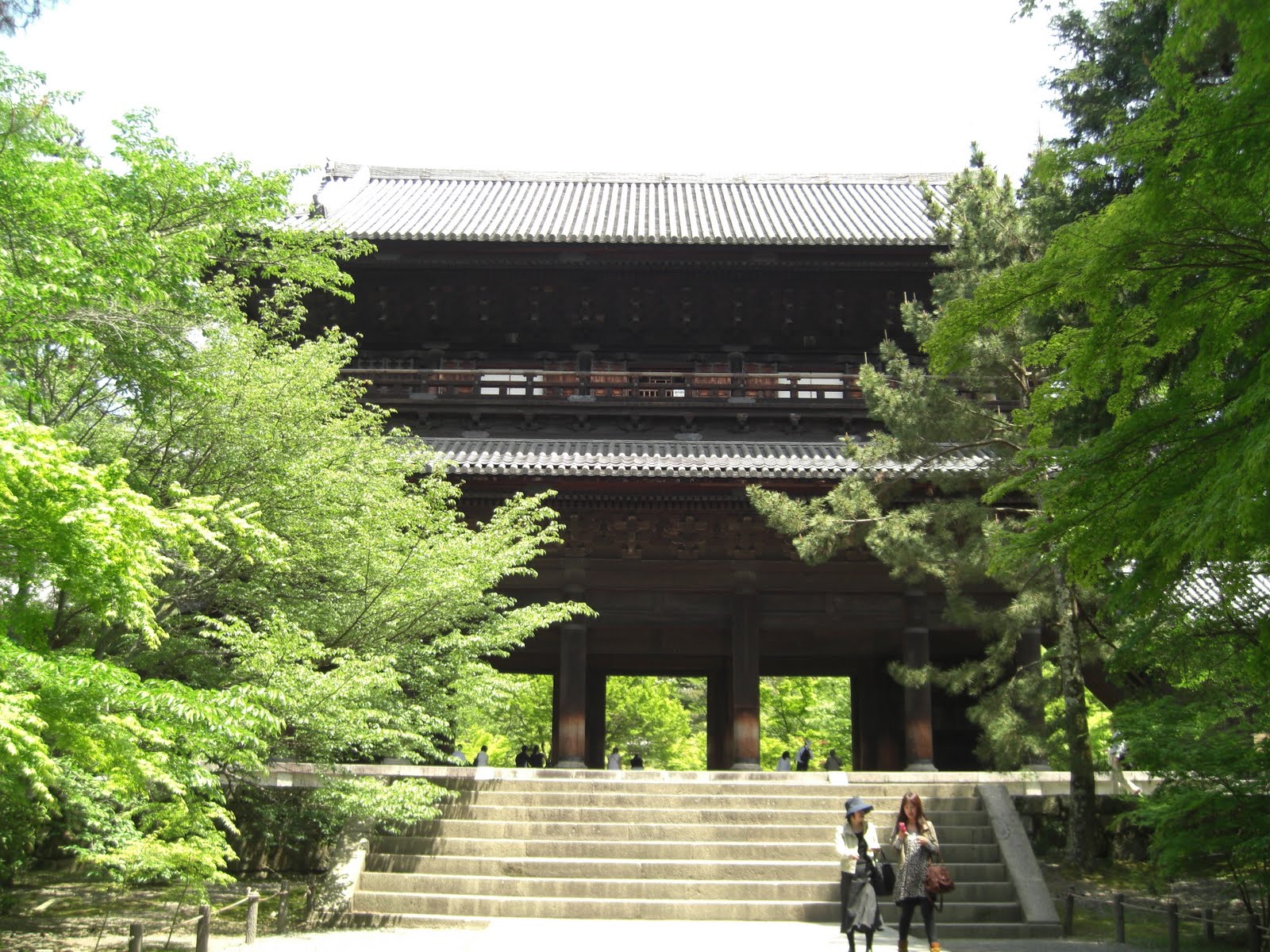
Nanzenji Temple☆

Nanzenji was built in 1291.
It takes 30min to get there from Kyoto station by bus.


I found lovely shape of a foof of tile!!!
It's rare this shape!!

I was able to find a another rare tile!!! It's dragon!!! cool !!


What a beautiful scenery.....
quiet....
only hear bird song & sound of wave trees...


I wasn't able to sit this deck><
If I could sit here, I definitelycould expererience ZEN!!!
Though , really really amazing places...

In old time , SAMURAI taked a walk this garden wearing KIMONO....
I can only wonder at the complete peace and serenity this garden...


This natural waterfall looks like dragon-shape.


This bridge was a water supply.


Gorlden Temple☆

Kinkaku( Gorlden Pavilion) is a popular name for one of the main
buildings of this temple, which is properly called Rokuon-ji Temple.

In the 1220's it was the comfortable villa of Kintsune Saionji.

Kinkaku was formally called Shariden. The elegant, harmonious
building consists of three types of architecture.
The first floor is Shinden-zukuri, the palace style. It is named Ho-sui-in.
The second floor is Buke-zukuri, the style of the samurai house and
is called Cho-on-do.
The third floor is Karayo style or Zen temple style. It is called
Kukkyo-cho. Both the second and third floors are covered with
gorlden-leaf on Japanese lacquer.

The roof, upon which the Chinese phoenix settles, is thatched
with shingles.


This huge pine trees is called Rikusyu-no-matsu.
This amazing pine tree is one of the three greatest pine trees in Kyoto.
This is shape of ship.

This classic tea house is called Sekka-tei. In Sekka-tei there is a
celebrated pillar made of a nandin. The house was restoned in 1997.


I found a funny one!!! This is English fortune!!!

Actually , there are a lot of fortunes at temple in Japan ...
But, I have never found non Japanese one.
It's really rare English, Korea, Chinese version!!!
This one is Korean Fortune!!

This one is Chinese fortune!!

When you visit here in Gorlden temple, please try the fortune!!!


Ryoanji Temple☆

A simple rock garden, consisting only of white sand and fifteen rocks,
laid out at the end of the 15th century, is acknowledged to be one
of the masterpieces of Japanese culture.


Its simple beauty will inspire philosophical meditation.

It is wisteria flowers. SOOOO beautiful & smell was amazing!!!!


Kyoyochi Pond
The pond was made in the late twelfth century. Until recent years
many mandarin ducks were to be seen on the pond.
Hence the Ryoanji was generally known as Oshidoridera.
The temple of mandarin ducks.
The water wells out from around the two rocks in the south.
On the islet named Bentenjima is a hall, in which an image
of Sarasvati has been housed.
It is Azalea. it was really beautiful!!!


Ryoanji temple have a peacful stone garden and beautiful pond!
It is amazing place!! this is my favorite place in Kyoto, actually.
I really recommend this place^^
Ryoanji is near the Gorlden temple.
It takes only 15min by walk from Gorlden temple!!!
You should go both of them!!!^^


AOI Matsuri on 15th of May☆

The Aoi Matsuri, now one of the Kyoto's three big festivals(Aoi, Gion
and Jidai), is one of the most solemn and graceful festivals in Japan
and has been well preserved throughout the ages since the 6th century.

It is named after aoi leaves(hollyhock), which are used to decorate the
costumes of the participants.

These leaves are believed to have all
sorts of powers, including protection against lightning and earthquakes,
and quaranteeing easy childbirth.

The procession consists of 511 people, 36 horses, 4 cows and 2 carriages,
and runs 1 kilometer from the front of the back.

The highlight of the festival is the saio-dai, a young woman(in the Heian period,
she was always an imperial princess) who rides on a palanquin in a multitude
of followers wearing the colorful clothing of the imperial court.
She is dressed in 12 layers of imperial Heian robes.


6/02/2010

Wisteria in UjiByodo-in Temple

I went to UjiByodo-in Temple to see wisterias.
Byodo-in is a Buddhist temple in the city of Uji.


I had a wonderful time to see them^^

Also I saw azaleas there. We enjoy to see

beautiful flowers there in May every year!!


Of course, we can look at the most famous building

in the temple is the Phoenix Hall.


This building is used for Japanes 10 yen coin as a design.

5/09/2010

Walk around Kyoto with Kimono


When you come to Kyoto, you would better to change your clothes to KIMONO.


Near by our Ryokan, there are some Rental KIMONO Shop.


Especially, I reccomand you to go to "Yume Kyoto".


This one is really nice shop. Here is websitehttp://www.yumekyoto-kimono.com/english/info.html


Please check it out.


This experience will help your trip to Japan makes better.


Also, I went there few days ago even though I wear Kimono every day for my work.
After borrowing kimono, take picture in Yasaka Shrine near by Gion Hatanaka